


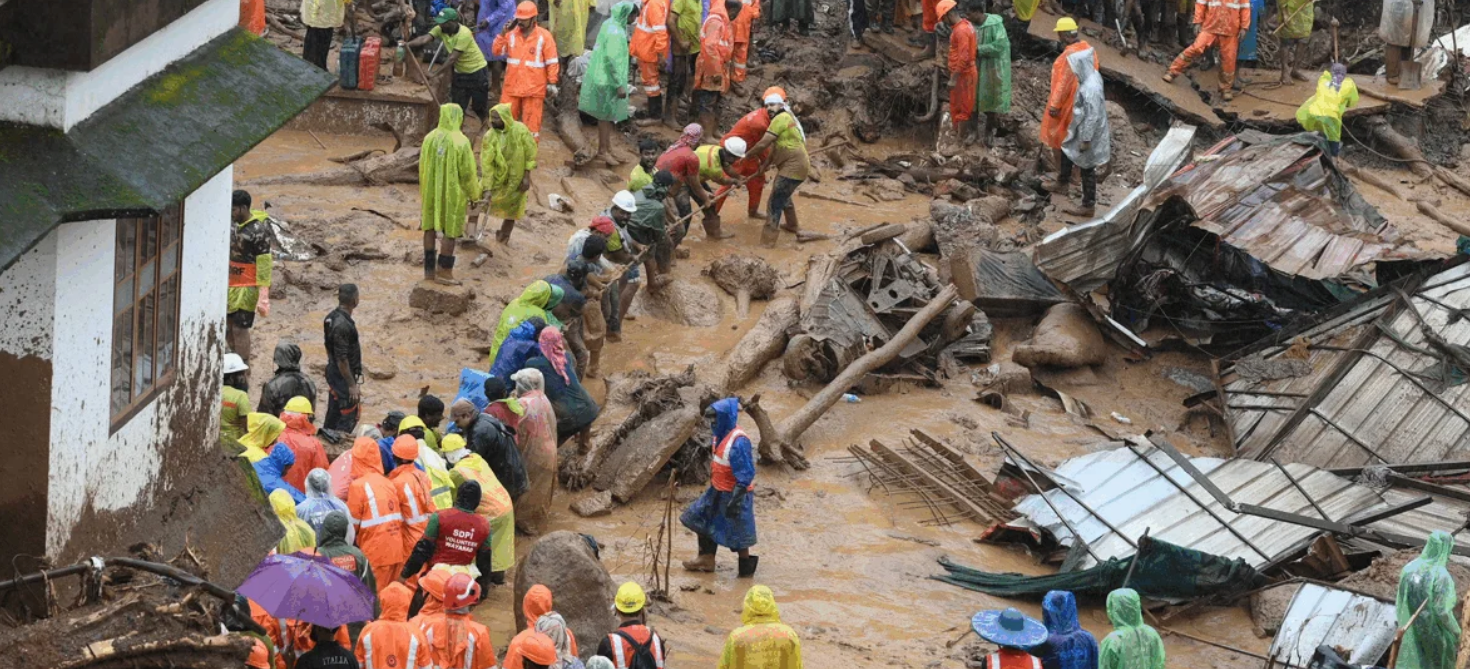
Many individuals are still unaccounted for, and rescue workers face challenging circumstances—such as soggy ground—while searching through demolished residences and structures for dead or survivors.
Two days after catastrophic landslides hit Kerala’s Wayanad district, rescuers found themselves in a race against time and in challenging conditions as they looked for survivors trapped in crumbled structures.
Local media accounts suggest that the official death toll is 190, although there may have been as many as 275 victims. With around 200 persons still unaccounted for, the death toll is predicted to increase.
On Thursday, Kerala Chief Minister Pinarayi Vijayan announced that for the previous three days, those who were still alive had been spared.
A number of obstacles have made rescue operations more difficult, including the unstable terrain created by collapsed roads and bridges and the lack of heavy machinery, which makes it challenging for rescue workers to remove mud and large uprooted trees that have fallen on homes and other structures.
At least 190 persons have died as a result of the landslides, according to Kerala Revenue Minister K. Rajan, despite unsubstantiated estimates indicating a total of over 275 fatalities.
The Wayanad district administration reports that 76 women and 27 children are among the deceased.
According to him, over 225 more people have been hurt, the most of them in Mundakkai and Chooralmala, the worst-hit districts.
On Thursday, Wayanad’s chief minister, Pinarayi Vijayan, announced that the rescue operation in the landslide-prone Mundakkai area might require many more days. A cabinet subcommittee comprising four ministers was formed to oversee the rescue operations.
In Wayanad, the four ministers will set up camp.
According to Vijayan, the district will be the camp for Revenue Minister K Rajan, Forest Minister A K Saseendran, PWD and Tourism Minister P A Mohamed Riyas, and SC/ST Department Minister O R Kelu.
In the areas of Wayanad affected by landslides, the anguish and cries of the rescued individuals reverberate over the eerie quiet of the dead, buried beneath mud and concrete debris. On TV screens, heartbreaking pictures of a father looking for his lost daughter and other people in similar circumstances appeared.
“256 autopsies have been done,” stated Veena George, state minister of health. Over 154 bodies have been turned over to the district management. Additionally, bodies discovered in Nilambur and Pothukal have been located and autopsies have been finished.”
1,300 workers from various agencies and the armed forces conducted cooperative search-and-rescue operations in the area, despite the rain, wind, and challenging terrain without the assistance of heavy gear, according to Minister K Rajan, who is coordinating the rescue efforts.
In addition, he said that 9,328 persons had been moved to 91 relief camps established within the area.
He added that of these, 2,328 individuals from 578 families that were uprooted by the landslides at Chooralmala and Meppadi have been relocated to nine relief camps.
In the area devastated by the landslip, there are still a number of unaccounted for persons. Rescue workers are battling unfavourable circumstances, such as soggy ground, while searching through demolished houses and structures for survivors or bodies.
The people most negatively impacted by the calamity were the tea plantation labourers who resided in the estate lanes of Mundakkai and Chooralmala. Even while rescue efforts are underway, it’s still unknown how many family members and employees of the tea farm perished in the catastrophe.
Chief Minister Pinarayi Vijayan had stated that the survivors of the Wayanad tragedy would benefit from the state’s experience in helping people rebuild their lives and livelihoods in the event of prior natural catastrophes when reporters enquired about rehabilitation efforts. Children affected by disasters will receive special attention when it comes to resuming their education, according to Vijayan, who also mentioned that they will be given the chance to do so from wherever.
On Thursday, the Indian Army’s Madras Engineering Group finished building the 190-foot Bailey bridge, which would assist link the Wayanad district’s most severely damaged districts, Mundakkai and Chooralmala, which were devastated by massive landslides on Tuesday.
Beginning at 9.30 p.m. on Wednesday, the bridge’s construction was finished by 5.30 p.m. on Thursday.
After the bridge’s construction was finished, Major General V T Mathew, GOC-Karnataka and Kerala Sub-Area, drove across it in his official car. The bridge can support 24 tonnes of weight.
Overlooking the Iruvanjippuzha River, Chooralmala and Mundakkai will be connected by the Class 24 Bailey Bridge being built in the Wayanad district.
More than 500 Army soldiers are involved in the search and rescue effort, according to Major General VT Mathew, General Officer Commanding, Karnataka and Kerala Sub Area, who made the announcement on Thursday.
Since the early hours of July 30, we have come here to support the people and government of Kerala. More than 100 dead have been retrieved, but there are still many more. The Major General remarked, “We have also saved a great number of lives.
In Wayanad, Chief Minister Pinarayi Vijayan presided over an all-party conference to discuss the landslip issue that left over 200 people dead. The APJ Abdul Kalam Memorial Hall in the Wayanad Civil Station served as the venue for the conference.
While acknowledging the difficulties in bringing in equipment to help with the rescue attempts, CM also pointed out how much the construction of the Bailey Bridge had made things easier.