


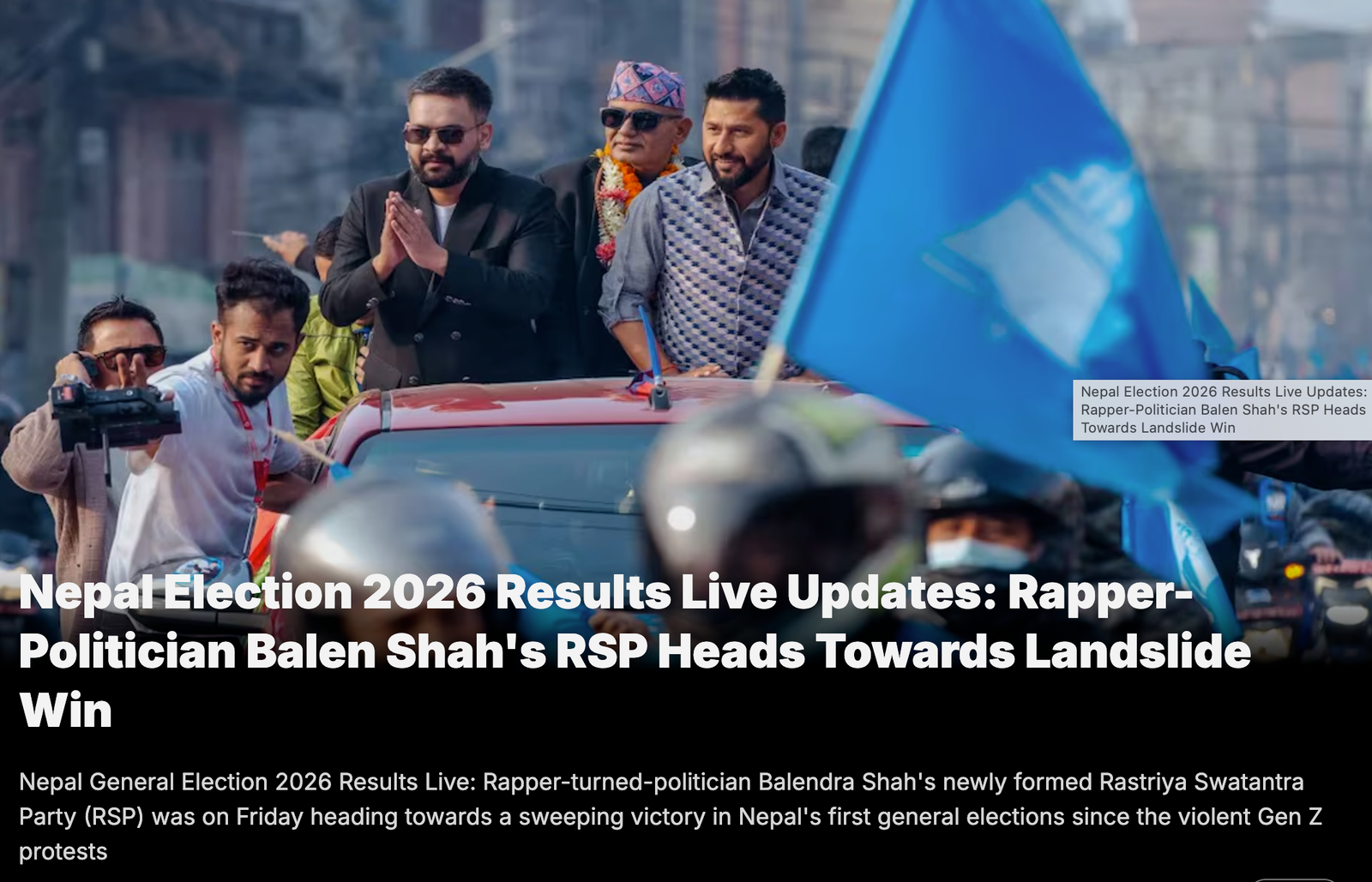
📰 Nepal Election Results 2026: Balen Shah’s Party Surges Ahead, KP Sharma Oli’s CPN-UML Struggles
Kathmandu: The Nepal General Election 2026 is shaping up to be one of the most dramatic political shifts in the country’s recent history. Early vote counting trends show the Rastriya Swatantra Party (RSP), led by popular young leader Balen Shah, taking a commanding lead across multiple constituencies.
According to the latest trends, RSP is leading in around 101 constituencies, putting the party in a strong position to potentially form the next government. Meanwhile, former Prime Minister KP Sharma Oli’s party, the Communist Party of Nepal Unified Marxist Leninist (CPN-UML), appears to be struggling to maintain its traditional support base.
Political observers say the results could mark a major generational shift in Nepal’s politics, with younger leaders and voters challenging long-established political parties.
Rise of Balen Shah and the Youth Wave
The political rise of Balen Shah has been one of the most remarkable developments in Nepal’s recent political history. Before entering politics, Shah was widely known as a rapper, engineer, and social media personality, gaining popularity among Nepal’s youth through digital platforms.
His strong stance against corruption, criticism of traditional political elites, and promise of governance reforms resonated strongly with young and urban voters. Because of this support base, the Rastriya Swatantra Party is often described as a Gen Z-backed political movement.
Shah’s political messaging focused on transparency, accountability, and economic reforms, which appealed particularly to young voters frustrated by unemployment, economic stagnation, and corruption in government institutions.
Nepal’s Electoral System Explained
Nepal elects members of its lower house of parliament, known as the House of Representatives, through a mixed electoral system that combines direct elections and proportional representation.
The parliament has 275 seats in total:
- 165 seats are filled through direct constituency elections using the First-Past-The-Post (FPTP) system.
- 110 seats are allocated through proportional representation, based on the share of votes each political party receives.
On election day, voters cast two ballots:
- One vote for an individual candidate in their constituency.
- One vote for a political party.
The results of the direct elections are counted first. Once those results are finalized, the remaining seats are distributed proportionally among parties according to their overall vote share.
Current Election Trends
According to the latest counting trends:
- Rastriya Swatantra Party (RSP) – Leading in around 101 seats
- Nepali Congress – Leading in around 10 seats
- Communist Party of Nepal Unified Marxist Leninist – Leading in around 10 seats
- Nepal Communist Party – Leading in around 8 seats
Although vote counting is still ongoing, analysts say the early trends indicate a strong performance by the RSP and a weakening of traditional political parties.
Key Victories in Kathmandu
Several RSP candidates have already secured important victories in the capital region.
Ranju Neupane (also known as Darshana) won the parliamentary seat from Kathmandu-1, marking an important win for the party.
Meanwhile, RSP candidate Shishir Khanal secured victory from Kathmandu-6, winning a second term in parliament.
Khanal received 27,719 votes, while his nearest rival Krishna Baniya Chhetri of the Nepali Congress secured 6,647 votes.
The CPN-UML candidate Aman Kumar Maskey finished third with 4,373 votes.
What RSP Needs to Form Government
To form a government in Nepal’s parliament, a party or coalition needs at least 138 seats.
Political analysts say if the Rastriya Swatantra Party reaches or comes close to this number, Balen Shah could become Nepal’s next Prime Minister.
Some experts believe that if Shah forms the government, he may bring in technocrats and younger leaders into his cabinet, marking a shift away from traditional political structures.
Strong Voter Turnout and Gen Z Participation
The Election Commission of Nepal reported that approximately 60 percent voter turnout was recorded in the election.
Officials highlighted that young voters played a crucial role, with Gen Z participation described as “unprecedented.” Many first-time voters turned out in large numbers, energized by political activism and recent youth-led protests.
Election officials credited improved voter education, cooperation from political parties, and strong security arrangements for the smooth conduct of the election.
First Election After the 2025 Gen Z Protests
This election comes just months after the major youth-led protests in 2025 that shook Nepal’s political establishment.
Thousands of young people took to the streets to protest corruption, unemployment, and restrictions on social media platforms. The demonstrations were initially peaceful but escalated after clashes between protesters and police.
The unrest led to widespread political pressure on the government led by KP Sharma Oli.
During the protests, several people were killed and thousands were injured, sparking nationwide debates about governance, democracy, and youth representation in politics.
Political Crisis and Interim Government
Following the unrest, Nepal experienced a major political crisis. Prime Minister KP Sharma Oli eventually stepped down from office amid growing public pressure.
In a historic development, former Chief Justice Sushila Karki was sworn in as interim Prime Minister, becoming the first woman to hold the position in Nepal’s history.
Her appointment came during a period of political instability and was seen as an effort to restore public confidence in the country’s democratic institutions.
Weather Delays in Mountain Districts
Despite the overall smooth conduct of the election, logistical challenges were reported in several remote mountainous districts.
According to the Election Commission, the transportation of ballot papers remained pending in Sankhuwasabha, Dolpa, and Gorkha districts due to adverse weather conditions.
Officials had planned to transport ballots using helicopters, but poor weather delayed the operation.
Young Candidates Challenge Veteran Politicians
Another significant feature of the 2026 elections has been the rise of younger candidates challenging veteran political leaders who have dominated Nepal’s politics for decades.
These younger candidates campaigned on issues such as economic reform, job creation, digital governance, and anti-corruption measures.
Their emergence signals a possible generational shift in Nepal’s political landscape, reflecting the growing influence of younger voters.
What Happens Next
Vote counting across Nepal is still underway, and final results are expected to be announced soon. However, early trends already suggest that Nepal may be heading toward a major political transformation.
If the Rastriya Swatantra Party maintains its lead and secures enough seats to form a government, it could mark the beginning of a new political era led by younger leaders and reform-focused policies.
For Nepal, this election represents not just a contest for power but also a crucial moment that may shape the country’s political direction, economic policies, and democratic institutions for years to come.
1️⃣ Kerala Story 2 Controversy: Makers Decline Screening of Film to Kerala High Court
2️⃣ The Kerala Story 2 Row: Film Makers Refuse Court Screening During Kerala High Court Hearing
3️⃣ Kerala High Court Hearing on The Kerala Story 2: Makers Decline to Show Film
4️⃣ The Kerala Story 2 Controversy Deepens as Makers Refuse Screening in Kerala High Court
5️⃣ Kerala Story 2 Legal Battle: Producers Decline Court Screening Amid Teaser Controversy